
Organising a corporate ski trip: the method
This guide is for the person who has inherited the file: a working back-schedule, the decisions in the right order, the information to collect and the traps to avoid. It is what we would do in your position.
✅ Full checklist
👥 10 to 300 people
The question to answer first
Not « which resort? », nor « what budget? ». But: what is this trip supposed to produce?
Rewarding a performance, bonding teams who don’t know each other, landing a strategy, reconciling two departments after a merger: these objectives do not produce the same trip. They do not even produce the same length.
A seminar whose objective has never been named becomes a list of activities. It goes well, everyone says thank you, and six months later nobody can say what it achieved — which makes the next one harder to fund.
Write the objective in one sentence before calling anyone. Everything else follows from it: the length, the format, the activities, and even the choice of resort.
Who does what, and when
For a group of more than 40 people. With a smaller headcount everything compresses, but the order of decisions stays the same.
| When | What you do | What we do |
|---|---|---|
| D-6 to D-4 months | Set the objective, an approximate headcount, two possible periods and a budget envelope | Scoping call, then a costed proposal with two or three argued destinations |
| D-4 to D-3 months | Decide the destination and get the budget approved internally | Place holds on accommodation and meeting rooms — these go first |
| D-3 months | Confirm, announce the dates to the teams | Turn the holds into firm bookings |
| D-2 months | Survey participants: ski ability, sizes, dietary requirements, medical constraints | Pass the survey to hire shops, ski schools and caterers |
| D-1 month | Circulate the programme and the kit list | Lock the activities, the supervision and the written bad-weather plan |
| D-1 week | Confirm the final list and departure times | Brief the suppliers, set meeting points and emergency contacts |
| The day | Be with your group, and nothing else | A coordinator on site from start to finish |
| D+1 week | Collect immediate feedback from participants | Debrief, single invoice, points to improve for next time |
Six choices, in the right order
Taking them out of order is the number one cause of files that drag: a resort gets chosen before the headcount is known, and everything has to be redone.
The objective
In one sentence. It determines everything else, including the length.
The headcount
Even approximate. It governs which accommodation is available, and therefore the resort.
The period
Two windows rather than a fixed date. It is the first budget lever. See seasonality.
The length
One day, two or three: the objective decides, not the budget.
The destination
It follows from the four above, never the reverse. See resorts.
The programme
Last. It is the easiest part to adjust once the frame is set.
Six things to collect from participants
This is the task organisers put off, and the one that costs most when it is done too late.
An internal form sent at D-2 months, with a reminder at D-6 weeks, is enough. Without this data you buy lift passes for people who never ski, you discover three dietary requirements the night before, and you lose an hour on the day handing out equipment in the wrong sizes.
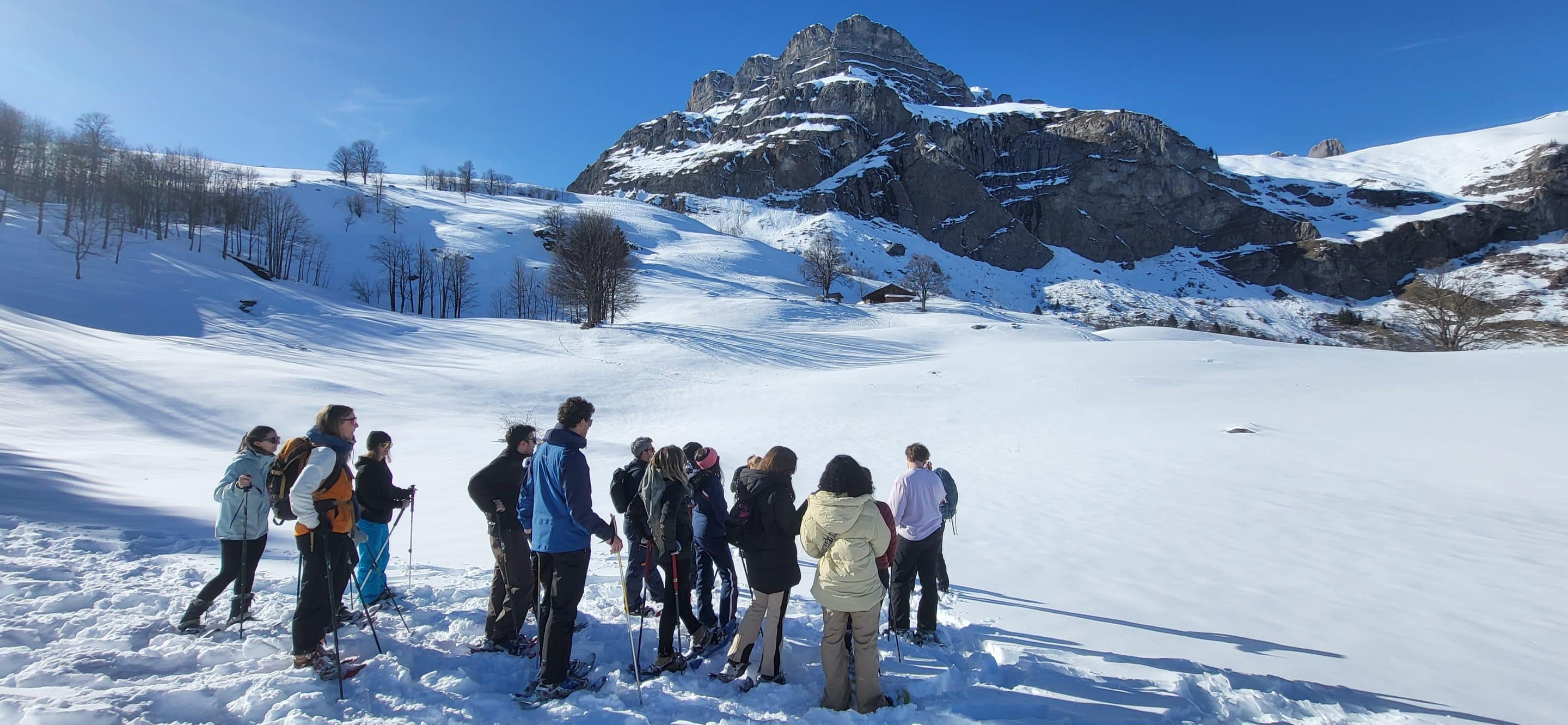
A survey completed at D-2 months is a briefing that starts on time on the day.
What gets prepared upstream, and forgotten
The kit list
Sent at D-1 month. A participant in trainers and a city coat disengages within twenty minutes, however good the programme is.
Insurance
Check your employees’ accident cover when travelling for work. Our activities are covered; free skiing falls under a different framework.
The rooming list
More sensitive than it looks. To be decided internally, never by the supplier, and never the night before.
Free time
Plan some. A programme with no breathing room prevents exactly what the trip is for: people talking to each other without a framework.
The leadership address
Short, placed at the right moment — usually at the close. It is what names the meaning of the trip.
Photographs
Appoint someone, or have it done. Without images the trip does not exist in the company’s memory — nor in next year’s budget case.
Organising: your questions
Do we need an agency?
Not necessarily, but weigh what it involves: a corporate ski trip means coordinating a hotel, a caterer, a ski school, an equipment hire shop, the lift company, a coach operator and the activity providers — each with separate contracts, deposits and cancellation terms. Doing it directly is feasible for a small group in a resort you already know. Beyond that, the time spent quickly exceeds the saving.
Can a corporate ski trip be organised in a month?
Yes for a ski incentive day or a small group, outside French school holidays. No for a group of 60 with overnight stays: the properties able to house everyone in one place will already be taken. In that case it is better to move the date than to degrade the trip.
Who pays: the company or the participants?
On a corporate seminar the company funds the whole thing and receives a single invoice: it is a management tool, not an individual benefit. The model where employees sign up and contribute belongs to the French works council framework — see an-weekendski.com.
What happens in the event of an accident?
Our activities are supervised by state-qualified professionals and covered by our professional liability insurance. The coordinator on site manages the emergency chain and keeps you informed. We ask for an emergency contact per participant in advance, which saves valuable time if it is ever needed.
You keep the decisions, we take the execution
Objective, headcount, two possible periods: that is all we need to start. The rest is our job.