
Ski and snow team building
Snow is a remarkably effective team building environment — on one condition : that the programme does not rest on skiing. Here are the activities that genuinely make a group work together, and how to choose the right one.
✅ No skiing required
⏱ 1.5h to a full day
🏔 Qualified instructors
Why snow does the work of a facilitator
Indoor team building asks people to play along. In the mountains, they don’t have to decide to : the terrain handles it.
Snow puts everyone in a situation that is slightly uncomfortable, and equally uncomfortable. You are cold, you slip, you fall, you laugh at yourself. That shared vulnerability unlocks relationships far more reliably than a workshop where everyone keeps their professional posture.
It also neutralises the company’s technical hierarchy. Nobody is an expert in igloo building. The CFO and the intern start level, and it is often the person you did not expect who takes the lead.
Finally, it produces stories worth telling. Six months later nobody remembers the indoor seminar ; everybody remembers who fell off the sled.
Seven workshops that actually work
All of them work without knowing how to ski. That is criterion number one : in a corporate group, a quarter to half of participants will never put on skis.
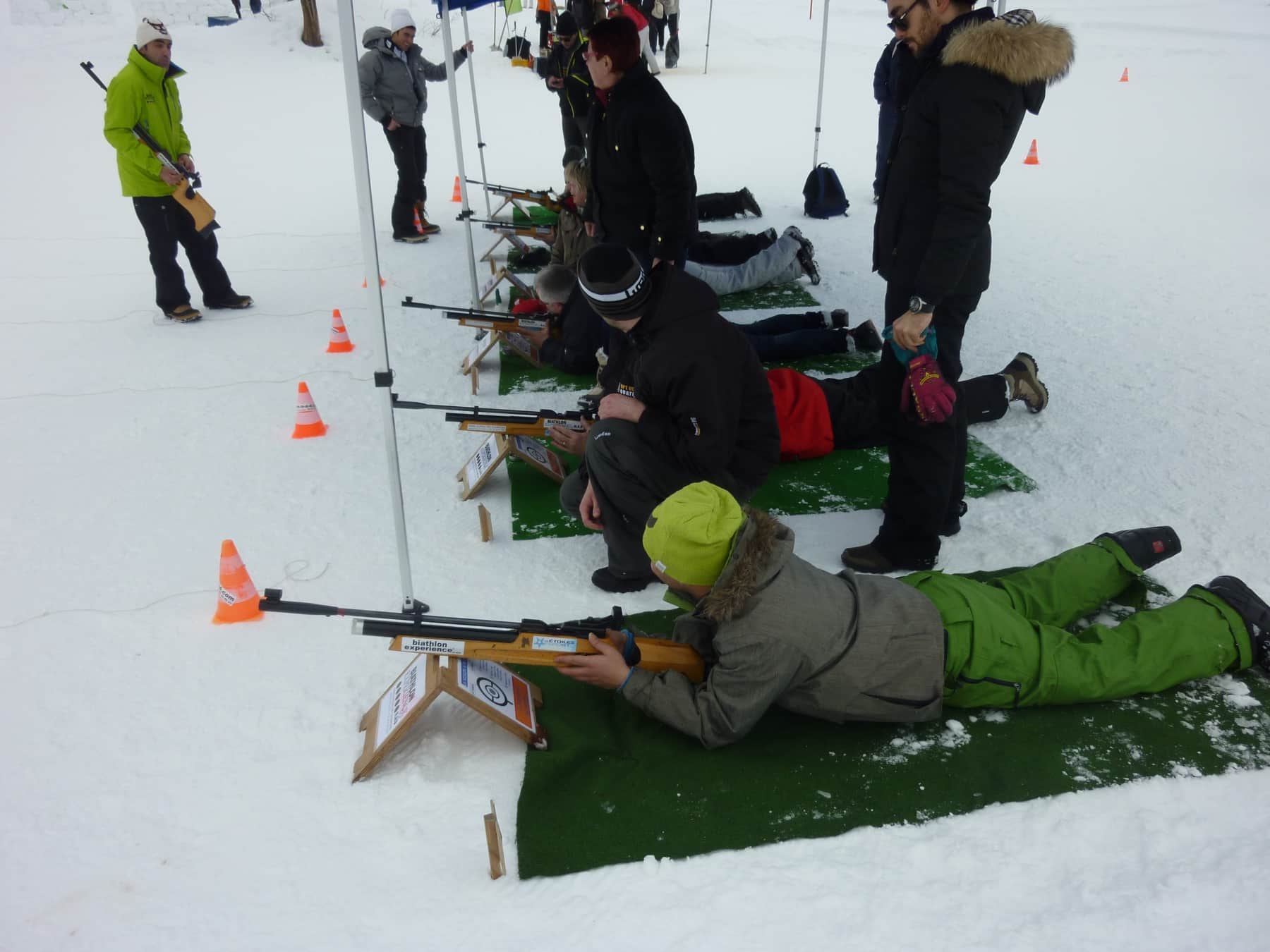
Laser biathlon
Team relay and rifle shooting. Learned in five minutes, fiercely competitive, and the ranking owes nothing to skiing ability.
The best default choice.
Snow olympics
Rotating workshops in mixed teams : sledging, skill, shooting, cohesion challenges. The format that mixes departments best.
Absorbs large headcounts.
Husky sledding
A first run with the musher, then guided driving. Strong emotional impact.
Needs rotation : plan slots.
Igloo building
Without assigned roles, the igloo collapses. The most literal cooperation exercise there is.
The debrief writes itself.
Giant skis
Four to six people on two shared skis. Impossible to move without synchronising : you fall, you restart, you find the rhythm.
As good to watch as to do.
Snowshoe walk
Small guided groups, through forest or across a nordic plateau. The format where people genuinely talk.
Often the favourite afterwards.
Torchlight descent
Closing the evening, led by instructors, followed by mulled wine. Can also be done on foot.
The image participants share.
Which activity for which objective ?
| Your objective | What we recommend | Why |
|---|---|---|
| Get departments who never speak to meet | Snow olympics | Teams are drawn at random and rotate : everyone works with people they never encounter |
| Create competition, reward | Laser biathlon | Real contest, readable ranking, a prize giving that gives you a highlight |
| Work on cooperation and roles | Igloo building or giant skis | Failure is immediate and visible if the group does not organise itself |
| Calm things down, allow real conversations | Snowshoe walk | Two hours walking side by side does more than a facilitated discussion |
| Make an impression, create the memory | Husky sledding | High emotional charge, heavily photographed and shared |
| Close an evening | Torchlight descent | Brings everyone outside together one last time, effortlessly |
A frequent mistake is trying to fit everything in. One highlight per day is enough. Two well-run activities beat five rushed ones, and the group needs informal time between workshops — that is often where the real value appears.
Non-skiers are not a problem to manage
This is the leading cause of failure on a corporate ski trip : treating non-skiers as a constraint and offering them something to fill the time while « the others » ski.
The group then splits into two camps, and the trip produces precisely the opposite of what was asked of it.
Our rule : the highlights are shared, skiing is the option. Every activity on this page works without knowing how to ski. Free skiing goes in the slots where everyone does as they please — never in the moment that matters.
What to know before choosing
Allow generously for time
An activity billed as « 2 hours » occupies half a day once kitting up, transfer, briefing and return are counted. It is the first source of unworkable schedules.
Headcount changes everything
Above 60 people most activities split into waves. You then need two workshops running in parallel and a gathering point, or half the group waits.
Cold is not a detail
A poorly equipped participant disengages within twenty minutes. We send a kit list in advance and lend what is missing : it saves more workshops than anything else.
Plan the fallback
Wind, fog, closed slopes : every programme ships with a written alternative. A cancelled activity with no plan B leaves a three-hour hole.
Snow team building : your questions
Do participants need to be fit ?
No. Laser biathlon, snow olympics, husky sledding and igloo building require no particular fitness. Only the snowshoe walk involves one to two hours of walking, and we adapt the route to the group. We always flag activities that are inadvisable for anyone with back or knee problems.
How many activities should we plan ?
One per day. On a two-day seminar that means one highlight on Day 2 afternoon, with the rest given over to free skiing, informal time and the evening. Programmes with three workshops a day produce exhausted participants who have spoken to nobody.
Can you run team building in bad weather ?
Yes for most of it : biathlon, snow olympics and igloo building work perfectly well while it snows — often more enjoyably. Strong wind is the real limit, since it closes the lifts and rules out high-altitude activities. In that case we move down to the valley or indoors.
Are the activities supervised ?
Always, by state-qualified instructors and mountain guides, with appropriate safety equipment and professional liability insurance. A coordinator from our team stays on site throughout the trip : they handle the surprises, not you.
Tell us what you want to produce
Bond, reward, integrate, reconcile : the objective shapes the programme far more than the budget does. Give us yours and we build around it.